How loud the city really is, where this noise comes from, and why it matters for
our health and daily lives.
By Anna Chen, Information Design 2025
New York is known as “the city that never sleeps,” not because of its lights, but
because of its sound. Even if every screen and billboard went dark, the city would remain awake: trains
screeching into stations, cars rolling over bridges, sirens slicing through traffic, garbage trucks
beeping in the dark at 3 a.m.
Noise here is not an interruption — it is a constant environmental condition.
🔊 Listen: Times Square at 11:30 PM
New York's soundscape is rarely defined by a single, sharp event, but by the high-density mix of
daily sources.
This is a field recording from Times Square at 11:30 PM: It serves as proof that
even if the lights went out, the city would remain awake. The audio captures a relentless layer of
traffic, idling engines, and voices—the permanent Ambient Hum that persists long
after dark.
01 — The Baseline
New York’s Default Volume
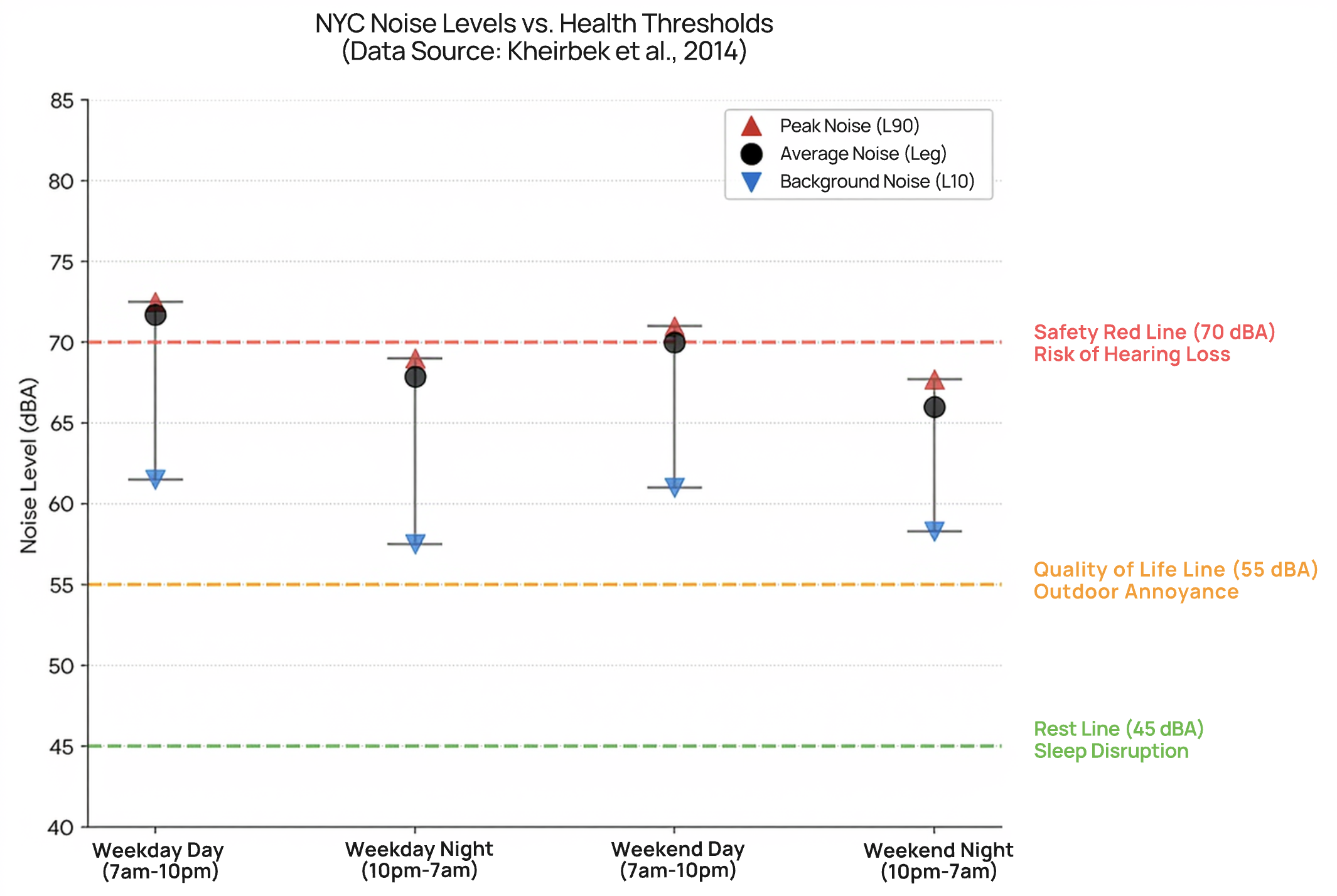
The World Health Organization recommends that night-time noise outside a bedroom window stay below 40 dB. Yet
many neighborhoods in New York remain between 60 and 70 dB throughout the day and night.
When we visualize week-long average sound levels from dozens of monitoring sites, a simple but harsh reality
emerges: New York almost never drops below 60 dB.
Graph 1: NYC Temporal Noise Profile vs. Health Thresholds. Even the quietest times
exceed the quality of life line.
Ideally, outdoor noise levels should be around 55 dB, yet residential streets often exceed that by 10 to 20
dB. Even when the city feels “normal,” the body is quietly under strain.
02 — The Hotspots
Where Complaints Concentrate
But these monitoring sites are only the surface. When we map the locations of noise complaints
citywide, a more human version of the soundscape reveals itself.
The density map shows where New Yorkers filed the most noise complaints in 2024. The most intense
hotspots — deep reds and oranges — cluster around Manhattan’s West Side, Midtown, and the South
Bronx.
03 — The Texture
Categorizing the Chaos
Once categorized, several patterns stand out:
Helicopter noise spikes dramatically around West 67th–75th Street, aligned with
Hudson River flight paths.
Residential noise is common in older buildings with poor insulation.
But complaints reflect what people find unbearable, not what is objectively loudest.
04 — The Commute
The City’s Loudest Daily Noise
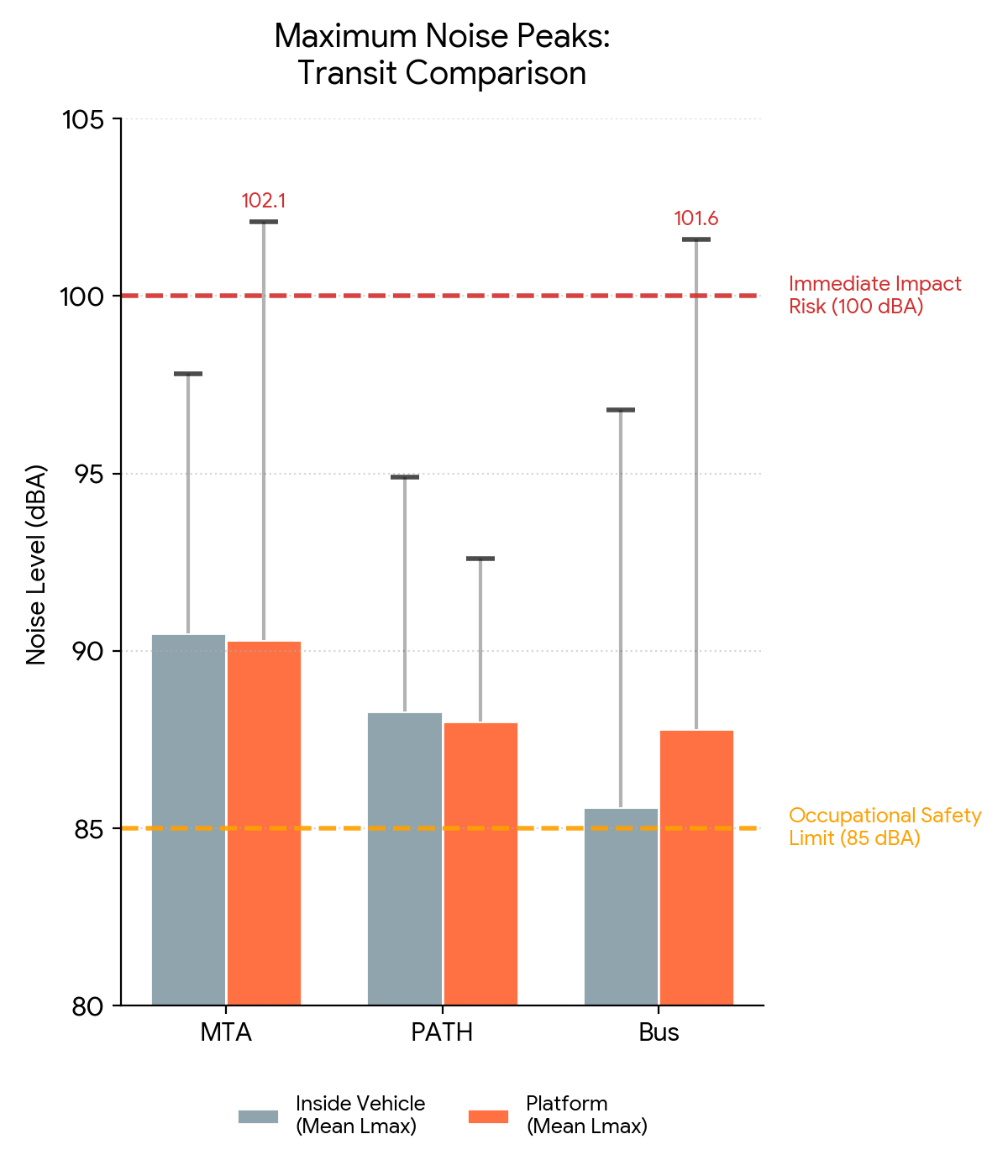
OSHA sets an 8-hour workplace noise limit at 85 dBA — but subway noise is not about averages. Peak levels on
platforms frequently reach 100–120 dBA, a range universally recognized as capable of
causing
immediate auditory damage.
Fig 4: Maximum Noise Peaks Comparison. MTA subway platforms frequently reach peak
levels that exceed immediate risk thresholds.
Transit isn’t just loud — it is one of the city’s most consistent and unavoidable sources of high-decibel
exposure.
05 — The Accumulation
Build the Noise: A Layered Soundscape
The sounds of New York rarely happen in isolation. The following mixer allows you to combine the elements you
see on the map and the sources you experience daily—from sirens and subway passes to general traffic—to
illustrate the density of the auditory environment.
Layer the Chaos
Interactive NYC Soundscape
🚗Traffic
🚆Subway Pass
🚇Inside Train
🚌Bus Idle
🚓Police
🚑Ambulance
📯Honk
🚧Drilling
06 — The Exposure
No Alternative Route
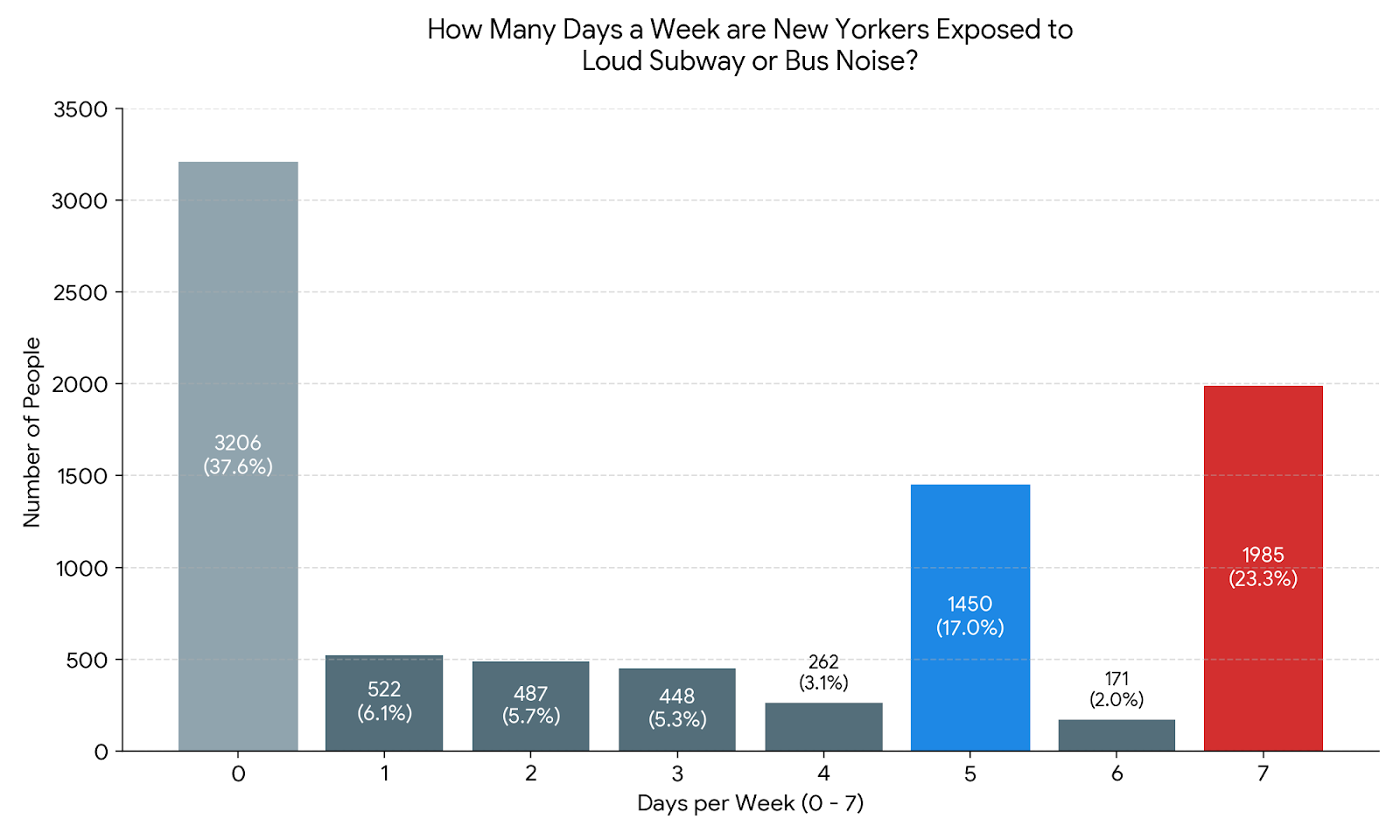
The data shows that thousands of New Yorkers are exposed to loud transit noise five to seven days a week,
meaning many are daily commuters.
Fig 5: Weekly Frequency of Exposure. Thousands of New Yorkers are exposed to loud
subway or bus noise 7 days a week.
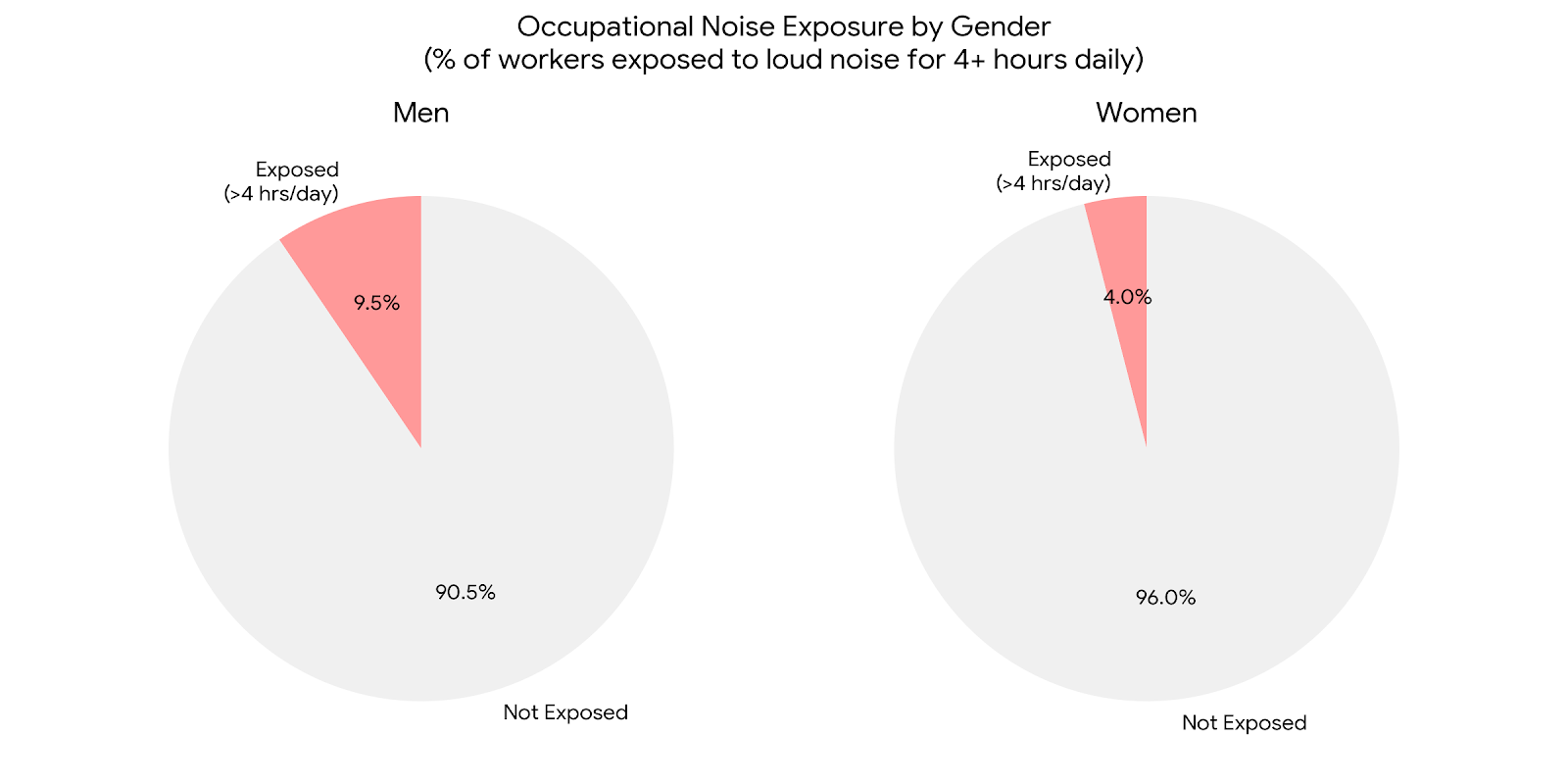
On top of that, about 9.5% of men and 4.0% of women experience more than four hours of loud noise at work
each day. This gap largely reflects occupational patterns.
Fig 6: Occupational Noise Exposure by Gender.
07 — The Coping
Headphones as Defense
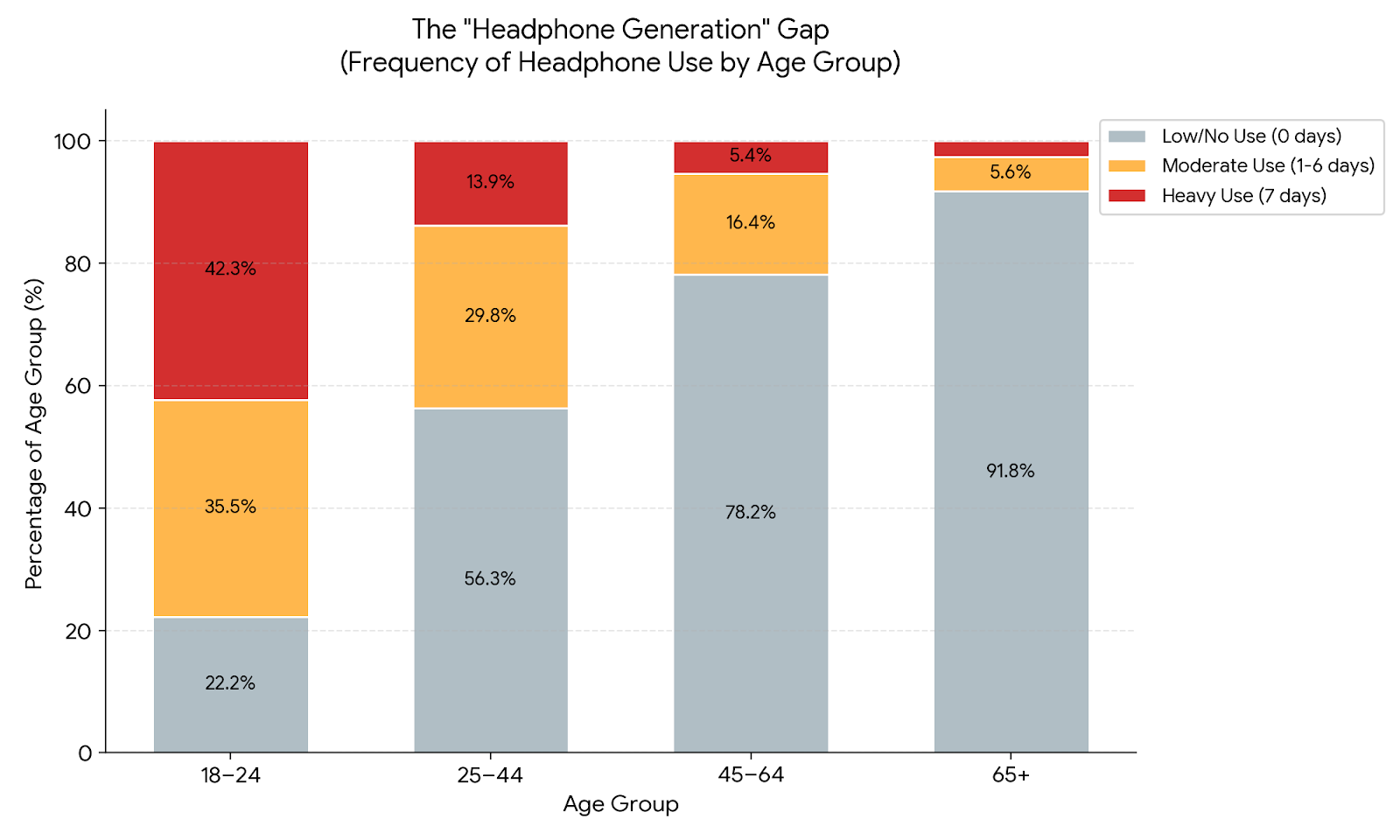
Noise affects more than health; it reshapes behavior. Younger New Yorkers, especially those aged 18–24, rely
heavily on headphones as a protective response: 42% wear headphones daily.
Fig 7: Headphone Usage by Age. A forced coping mechanism for the younger generation.
What begins as a buffer quickly becomes another source of auditory strain — internal noise layered on top of
external noise.
08 — The Silent Threat
The Unseen Cost of Chronic Exposure
The impact of noise stretches far beyond temporary discomfort. Today, environmental noise is recognized as a
genuine public health concern. Even levels that feel “normal” in New York—around 60–70 dBA—can activate the
body’s stress response throughout the day.
During waking hours, this contributes to reduced concentration, irritability, and elevated stress hormones.
At night, recurring noise spikes disrupt deep sleep, leading to fragmented rest and long-term sleep
deprivation.
Over years, these effects accumulate. Research links chronic noise exposure to:
Higher blood pressure and increased hypertension risk
Greater likelihood of heart attacks and strokes
Elevated cortisol contributing to anxiety and mental fatigue
For many New Yorkers, coping strategies—noise-canceling headphones, closing windows, rearranging rooms—are
practical, but they do not fully address the underlying issue.
09 — The Future
A Citywide Challenge, A Shared Experience
New York’s soundscape is shaped by infrastructure: subways, sanitation routes, helicopters, aging buildings,
and dense traffic patterns. These layers create an environment where noise isn’t just an occasional event—it
is part of everyday life for millions.
Understanding this system does not solve it overnight, but it gives us a clearer foundation to imagine what a
healthier sound environment could look like:
Quieter transit technologies
Better building insulation
Smarter routing of aircraft and trucks
Equitable enforcement of noise codes
Urban planning that considers acoustic health as seriously as air and light
Why This Matters
Most importantly, raising awareness is a first step. Noise affects concentration, sleep, mental well-being,
and long-term health, yet it often remains invisible because we adapt to it.
This project is not a solution by itself—but it is an attempt to make the issue visible, audible, and easier
to talk about.
If more of us understand how the city sounds, we can better advocate for how we want the city to feel.